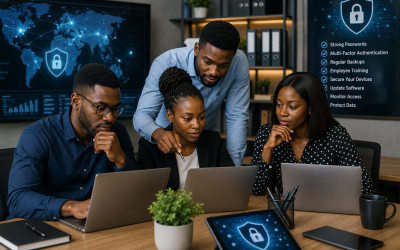
In today’s digital business environment, cybersecurity is no longer a concern only for large organisations.
Small businesses increasingly rely on websites, email, cloud storage, online payments, customer databases, and digital communication tools. While technology creates many opportunities, it also exposes businesses to risks such as phishing, weak passwords, malware, unauthorised access, and data loss.
A cybersecurity incident can disrupt business operations, affect customer trust, and potentially result in financial or data-related losses.
The good news is that many common cybersecurity risks can be reduced through proper awareness, good technology practices, and appropriate security measures.
In this article, we explore common cybersecurity threats facing small businesses and practical steps that can help reduce risk.
1. Use Strong and Unique Passwords
Weak or reused passwords can make it easier for unauthorised individuals to gain access to business accounts.
Employees often use multiple online platforms, including:
- Business email
- Cloud storage
- Customer management systems
- Social media accounts
- Website administration panels
- Financial or payment platforms
Using the same password across multiple accounts increases risk. If one account is compromised, other accounts using the same password could also become vulnerable.
Businesses should encourage the use of:
- Strong passwords
- Unique passwords for important accounts
- Password managers where appropriate
- Multi-factor authentication (MFA)
Multi-factor authentication provides an additional layer of security by requiring another form of verification beyond a password.
2. Be Careful of Phishing Emails and Messages
Phishing is one of the most common methods used to trick individuals into revealing sensitive information or clicking malicious links.
A suspicious message may appear to come from:
- A bank
- A colleague
- A customer
- A government organisation
- A technology provider
- A delivery company
The message may create urgency by claiming that an account will be closed, a payment has failed, or immediate action is required.
Before clicking a link or downloading an attachment, take time to verify the sender and the request.
Businesses should train employees to look out for warning signs such as:
- Unusual sender addresses
- Unexpected attachments
- Suspicious links
- Requests for passwords or sensitive information
- Urgent or threatening language
- Messages containing unusual spelling or grammar
When in doubt, verify the request through an official communication channel.
3. Keep Software and Systems Updated
Outdated software can contain security vulnerabilities.
Businesses should regularly update:
- Operating systems
- Web browsers
- Business applications
- Website software
- Plugins and extensions
- Security tools
Software updates often include important security improvements.
Where possible, businesses can enable automatic updates for supported systems. However, critical business systems should also be managed carefully to ensure updates do not disrupt important operations.
4. Protect Your Business Email
Email is one of the most important communication tools for businesses, but it is also a common target for cyber threats.
A compromised business email account can expose sensitive conversations, customer information, financial details, and internal documents.
To improve email security:
- Use strong and unique passwords.
- Enable multi-factor authentication.
- Review suspicious login activity.
- Avoid sharing account credentials.
- Be cautious with unexpected attachments and links.
- Remove access when an employee leaves the organisation.
Business owners should also ensure that employees understand how to recognise suspicious messages.
5. Back Up Important Business Data
Data loss can occur for many reasons, including:
- Hardware failure
- Accidental deletion
- Malware
- Ransomware
- Human error
- Technical problems
Regular backups can help businesses recover important information if something goes wrong.
Important data may include:
- Customer information
- Business documents
- Financial records
- Project files
- Website data
- Databases
Businesses should have a clear backup process and periodically check that backups can actually be restored when needed.
A backup that cannot be recovered may provide little value during an emergency.
6. Control Access to Business Information
Not every employee needs access to every system or document.
Providing access based on job responsibilities can help reduce unnecessary exposure to sensitive information.
For example, businesses can:
- Create individual user accounts.
- Avoid sharing one password among multiple employees.
- Limit administrative access.
- Review user permissions regularly.
- Remove access when staff members leave or change roles.
Good access management helps businesses maintain better control over their systems and information.
7. Secure Your Website
For many businesses, a website is an important part of daily operations.
An outdated or poorly maintained website can create security and performance risks.
Basic website security practices can include:
- Keeping the website platform updated
- Updating plugins and themes
- Using reputable hosting services
- Installing appropriate security tools
- Using secure administrator credentials
- Backing up the website regularly
- Limiting unnecessary administrator access
Businesses that collect customer information through forms or online systems should also consider appropriate data protection and security practices.
8. Be Careful When Using Public Wi-Fi
Public Wi-Fi networks can present additional security risks, particularly when accessing sensitive business accounts.
When working remotely, employees should be cautious about accessing important systems through unknown or unsecured networks.
Where appropriate, businesses can consider secure remote access solutions and encourage employees to follow clear security guidelines when working outside the office.
9. Create a Basic Cybersecurity Policy
A small business does not necessarily need a complex cybersecurity document to begin improving its security practices.
A basic policy can provide employees with clear guidance on issues such as:
- Password management
- Email security
- Use of personal devices
- Data storage
- Access permissions
- Software updates
- Reporting suspicious activity
- Remote working practices
The goal is to ensure that everyone understands their responsibilities.
Technology alone cannot protect a business if employees are unaware of basic security practices.
10. Have a Plan for Security Incidents
Even with good security practices, no organisation can eliminate every possible risk.
Businesses should think about what they would do if they experienced:
- A compromised email account
- Lost business data
- A hacked website
- Malware or ransomware
- Unauthorised access to systems
A basic incident response plan can help the business respond more quickly and reduce confusion.
The plan may include:
- Identifying the affected system.
- Limiting further access or damage.
- Informing the appropriate internal team or IT professional.
- Preserving relevant information.
- Recovering systems and data where possible.
- Reviewing what happened and improving security measures.
Common Cybersecurity Mistakes Small Businesses Should Avoid
Some common mistakes include:
Using the Same Password Everywhere
A compromised password could create risks across multiple accounts.
Ignoring Software Updates
Delaying important updates may leave systems exposed to known security issues.
Clicking Links Without Verification
Employees should always verify unexpected or suspicious messages.
Failing to Back Up Important Data
Regular and tested backups can support recovery after technical or security incidents.
Giving Everyone Full Access
Access should be based on what each employee needs to perform their role.
Assuming Cybercriminals Only Target Large Companies
Businesses of different sizes can face cyber threats, making basic cybersecurity practices important for everyone.
A Simple Cybersecurity Checklist for Small Businesses
Before the end of the week, consider reviewing the following:
- Are strong and unique passwords being used?
- Is multi-factor authentication enabled on important accounts?
- Are employees aware of phishing risks?
- Is important business data backed up regularly?
- Are software and systems updated?
- Are access permissions reviewed regularly?
- Is the business website properly maintained?
- Do employees know how to report suspicious activity?
- Is there a basic plan for responding to a security incident?
Small improvements can contribute to a stronger overall security posture.
Recent Posts
-
 University of East London: Why African Students Are Choosing UEL for UK Study in 2026
 -
 AI Agents in 2026: How Small Businesses Can Automate More Than Ever
 -
 10 Ways Artificial Intelligence Is Transforming Small Businesses in 2026
 -
 Commonwealth Master’s Scholarships 2027/28: A Major UK Study Opportunity for African Students
 -
 UK Student Visa Financial Requirements 2026: How Much Money Do International Students Need?