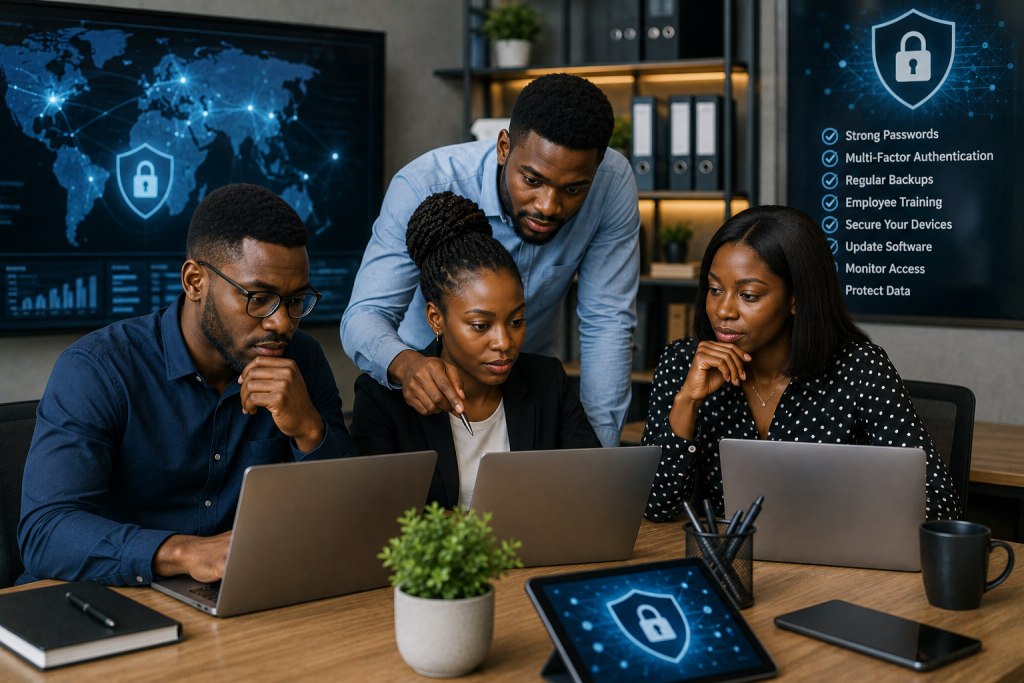
As Nigerian businesses continue to adopt websites, cloud platforms, online payments, social media, digital banking, artificial intelligence, and other technology solutions, cybersecurity is becoming an increasingly important part of doing business.
Cybersecurity is no longer a concern reserved for banks, government institutions, or large corporations.
Small businesses are also attractive targets because they may hold valuable customer information, financial records, email accounts, payment information, business documents, and access credentials while having fewer resources dedicated to security.
Nigeria’s cybersecurity environment is becoming increasingly challenging. The Nigeria Computer Emergency Response Team (ngCERT) reported a significant rise in high-impact incidents involving phishing, ransomware, business email compromise and data breaches, with AI-enabled techniques making some attacks easier to scale.
Deloitte’s Nigeria Cybersecurity Outlook 2026 similarly highlights increasing risks from phishing, ransomware, identity attacks and insecure software, while noting that these threats are not limited to large organisations.
So, what can a small business do to protect itself?
Here are 10 practical cybersecurity measures every Nigerian small business should consider in 2026.
1. Use Strong and Unique Passwords
Passwords remain one of the simplest ways to protect your digital accounts.
Unfortunately, many businesses still use weak or repeated passwords across multiple platforms.
Avoid passwords based on:
- Company names
- Staff names
- Phone numbers
- Birthdays
- Simple number combinations
- Common words
Instead, use strong, unique passwords for important accounts such as:
- Business email
- Banking platforms
- Website administration
- Social media
- Cloud storage
- Accounting software
- Customer management systems
A password manager can also help businesses securely manage multiple passwords.
2. Enable Multi-Factor Authentication
A password alone may not be enough to protect an important account.
Multi-factor authentication (MFA) adds another layer of security by requiring an additional verification method.
Depending on the service, this may involve:
- An authentication app
- A security key
- A verification code
- Biometric verification
- Another approved authentication method
Enable MFA on critical business accounts wherever it is available.
Prioritise:
- Email accounts
- Banking and financial platforms
- Cloud services
- Website administration
- Social media accounts
- Business management systems
If an attacker obtains your password, MFA can provide an additional barrier against unauthorised access.
3. Train Employees to Recognise Phishing
One of the biggest cybersecurity weaknesses in a business can be its people.
Attackers may send convincing emails, WhatsApp messages, text messages, or other communications designed to trick employees into:
- Clicking malicious links
- Revealing passwords
- Sending money
- Downloading malicious files
- Sharing confidential information
- Giving access to an account
AI is also making fraudulent communications increasingly convincing.
Deloitte’s 2026 Nigeria Cybersecurity Outlook notes that attackers can use AI to create more realistic emails, messages and voice communications that imitate trusted individuals or organisations.
Train employees to pause before responding to unexpected requests.
For example, if someone receives a message requesting an urgent bank transfer, they should verify the request through an independent communication channel before taking action.
4. Back Up Your Important Business Data
Imagine losing your:
- Customer database
- Accounting records
- Contracts
- Business documents
- Website files
- Employee records
- Project information
What would happen to your business?
Regular backups can significantly reduce the impact of data loss, ransomware, hardware failure, or other incidents.
Important information should be backed up using an appropriate strategy that may include:
- Cloud backups
- External storage
- Automated backups
- Off-site backups
But backing up data is only part of the process.
Test your backups.
A backup that cannot be restored when you need it is not an effective recovery solution.
5. Keep Your Software Updated
Software developers regularly release updates to fix security vulnerabilities and improve functionality.
This includes:
- Operating systems
- Website software
- WordPress plugins
- Mobile applications
- Browsers
- Business applications
- Antivirus and security software
Ignoring updates can leave known vulnerabilities unaddressed.
Businesses should establish a routine for checking and applying important security updates.
If your website uses WordPress or another content management system, make sure the core platform, themes, and plugins are properly maintained.
6. Protect Your Business Email
Business email accounts can be extremely valuable targets.
An attacker who gains access to a company email account may be able to:
- Read confidential conversations
- Impersonate employees
- Request fraudulent payments
- Reset passwords
- Access other services
- Steal sensitive documents
This is particularly dangerous for businesses that communicate with banks, suppliers, customers, universities, partners, or financial institutions through email.
Consider implementing:
- MFA
- Strong passwords
- Account monitoring
- Email security controls
- Staff awareness training
- Appropriate access permissions
Employees should also be careful with unexpected attachments and links.
7. Limit Employee Access
Not every employee needs access to every business system.
For example, an employee responsible for social media may not need access to:
- Payroll
- Banking
- Customer databases
- Server administration
- Financial records
Use the principle of least privilege: give users only the access they need to perform their responsibilities.
This can reduce the potential impact if an account is compromised.
When an employee leaves the organisation, promptly review and disable access that is no longer required.
8. Secure Your Website
Your website is an important part of your digital identity.
A compromised website can damage:
- Customer trust
- Business reputation
- Search visibility
- Sales
- Customer data
- Brand credibility
Businesses should consider:
- Keeping website software updated
- Using strong administrator passwords
- Enabling MFA where supported
- Using HTTPS
- Removing unnecessary plugins
- Restricting administrator access
- Maintaining regular backups
- Monitoring suspicious activity
Security should be considered during website development—not added only after something goes wrong.
Deloitte’s 2026 outlook specifically highlights the increasing exposure created by applications, APIs, cloud platforms and software that is deployed without sufficient security testing.
9. Be Careful With Business Payments
Cybercriminals may attempt to manipulate businesses into making fraudulent payments.
For example, an attacker may impersonate:
- A supplier
- A director
- A manager
- A customer
- A bank representative
A simple email saying:
“Please change the bank account details for our next payment.”
could potentially result in a serious financial loss.
Establish a payment verification procedure.
For significant or unusual transactions, consider confirming the request through an independent channel, such as a verified phone number or an established contact.
Do not rely solely on the email address provided in the suspicious message.
10. Have a Cybersecurity Incident Response Plan
Even with strong security measures, businesses should prepare for the possibility that something may go wrong.
Ask yourself:
What would we do if our business email was hacked tomorrow?
Or:
What would we do if our website went offline or our files became inaccessible?
A simple incident response plan can identify:
- Who should be contacted
- Who has authority to make decisions
- How compromised accounts will be secured
- How backups will be restored
- How customers will be informed
- When external IT or cybersecurity professionals should be contacted
- How evidence and records should be preserved
Preparation can reduce confusion during an actual incident.
Why Cybersecurity Matters for Small Businesses
Cybersecurity is not only about preventing hackers.
It is also about protecting trust.
Customers expect businesses to protect their information.
Partners expect businesses to communicate securely.
Employees expect their personal and professional information to be handled responsibly.
A serious cybersecurity incident can result in:
- Financial losses
- Operational disruption
- Data loss
- Reputation damage
- Customer complaints
- Regulatory consequences
- Loss of business opportunities
PwC’s 2026 Nigerian CEO survey found that cybersecurity and talent availability were among the top threats identified by Nigerian CEOs, with 75% of surveyed CEOs planning to strengthen enterprise-wide cybersecurity over the next three years.
This demonstrates that cybersecurity is increasingly being viewed as a business priority, not simply an IT issue.
A Simple Cybersecurity Checklist for Your Business
Use this quick checklist to assess your current security:
Accounts
- Strong passwords are being used
- Passwords are not reused across important accounts
- MFA is enabled
- Former employees no longer have unnecessary access
Data
- Important files are backed up
- Backups are tested regularly
- Sensitive information is appropriately protected
- Access to confidential information is restricted
Website
- Website software is updated
- Plugins and themes are maintained
- Administrator accounts are protected
- Website backups are available
Employees
- Staff receive cybersecurity awareness training
- Employees know how to identify suspicious messages
- Payment requests are independently verified
- Employees understand how to report incidents
Business Continuity
- There is an incident response plan
- Important contacts are documented
- Recovery procedures are understood
- Critical business operations can continue after disruption
What Should a Small Business Do First?
If your business currently has very limited cybersecurity protection, do not become overwhelmed.
Start with the basics.
First: Protect Your Email
Enable MFA and secure administrator accounts.
Second: Protect Your Data
Back up important business information.
Third: Train Your Staff
Teach employees how to identify phishing and suspicious requests.
Fourth: Secure Your Website
Keep software updated and maintain regular backups.
Fifth: Create an Incident Plan
Know what you will do if an account, device, website, or business system is compromised.
These basic measures can significantly improve your security posture without requiring a massive technology budget.
Recent Posts
-
 University of East London: Why African Students Are Choosing UEL for UK Study in 2026
 -
 AI Agents in 2026: How Small Businesses Can Automate More Than Ever
 -
 10 Ways Artificial Intelligence Is Transforming Small Businesses in 2026
 -
 Commonwealth Master’s Scholarships 2027/28: A Major UK Study Opportunity for African Students
 -
 UK Student Visa Financial Requirements 2026: How Much Money Do International Students Need?